
Behind The Curtain: Maureen Reagan Reflects on 39 Years at Krannert Center
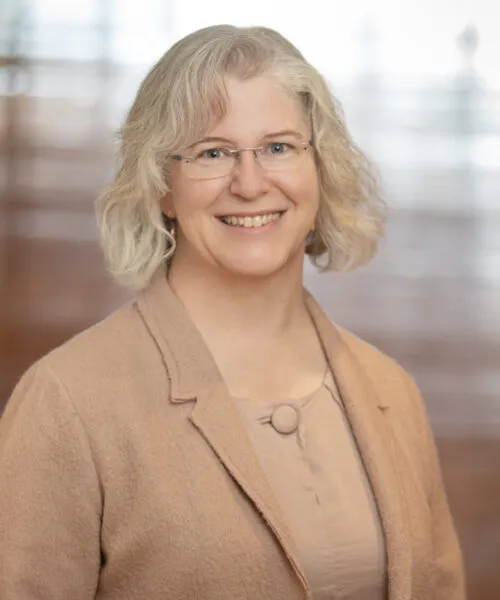
At 2 a.m., after Krannert Center’s 25th anniversary celebration in 1994, Maureen Reagan was finally ready to go home. However, after hours of exhausting-but-exciting work, slumber would have to wait a bit longer.
“I dropped a Ziploc bag full of chili on the ticket office floor and had to clean it up,” Reagan recalls. “I was so tired, but colleague Rebecca McBride got me laughing and pitched in, which helped us have fun rather than frustration.”
It is a wonderfully appropriate story for someone who spent nearly four decades at Krannert Center: a little chaotic, a little surreal, and ultimately a reminder of how many people it takes to make the performing arts happen.
Reagan came to Krannert Center as a University of Illinois student in 1987. Thirty-nine years later, on September 30, she retired from her final position as Associate Director for Patron Experience and Administration. Today, she can look back on a career that has touched virtually every corner of the organization and many aspects of her own life.
“If somebody else said, ‘Oh, I worked at the same place for 39 years,’ I would think that was a really long time, but it doesn’t feel like that for me,” she says.
Maureen grew up in Ottawa, Illinois, about 90 miles southwest of Chicago, in a family where music was simply part of everyday life.
“I don’t remember ever not being around music,” she says.
Her mother played piano and organ and sang. Reagan’s first arts experiences included singing in church choir and attending performances of community theatre and the Ottawa Community Concert Association, which brought visiting artists to her hometown each year.
Then there was Bill Myers, a high school teacher who created an annual week-long fine arts festival with his students. “Myers empowered the student committee to make the festival happen, with his mentorship, Reagan says. “We planned the bookings, worked the events, hosted the artists. The whole school attended during that week and also shared their own talents.”
The festival brought groups from the University of Illinois, including Champaign's traditional jazz group Medicare 7, 8, or 9, theatre from Chicago, and many other artists, including author Gwendolyn Brooks and musician John Hartford.
“I was fortunate to spend a whole day with Brooks and with Hartford,” Reagan recalls. “And I didn’t know it at the time, but I think that really led me into what I ended up doing.”
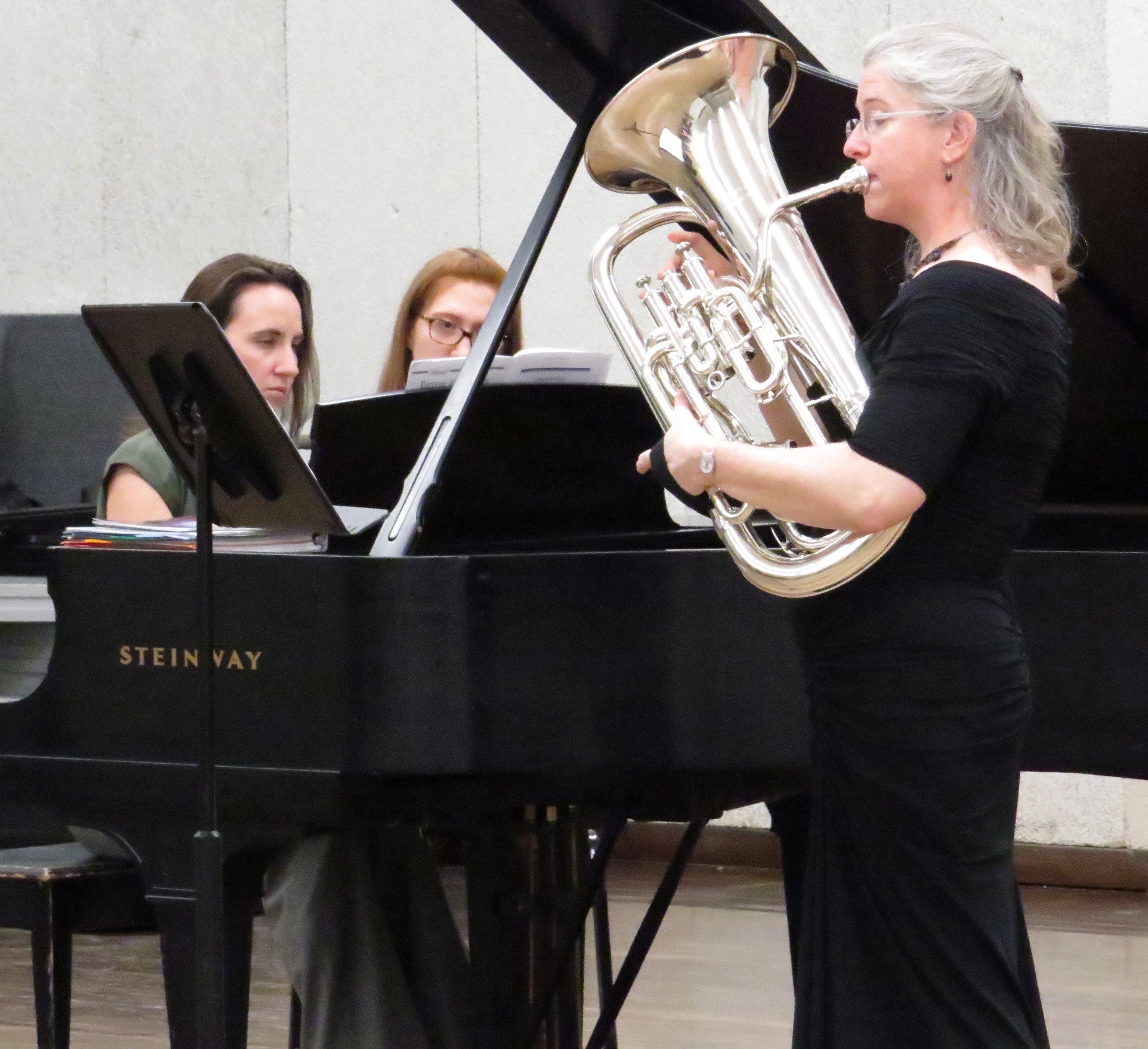
What she ended up doing, at least initially, involved a euphonium.
She began playing tuba in third grade because the school band needed a tuba player and, as she puts it, “the band director knew my parents wouldn’t let me quit.” By junior high, shewanted the melody a little more often, so she switched to euphonium.
“It’s a beautiful sound,” she says. “Its name means 'sweet sounding,' and that’s really what I have loved about it… the range and the tone.”
Reagan came to the University of Illinois intending to study music education, although she soon discovered that teaching wasn’t quite her calling.
Why the University of Illinois at Urbana-Champaign?
“Two things. First, they knew what a euphonium was.”
The second reason was opportunity. Illinois was large enough to offer possibilities beyond music if she decided to change direction.
She earned a Bachelor of Music in euphonium performance, with her eye on pursuing arts administration. Along the way, she found mentors, became involved in student leadership (thanks to mentor-of-many Dan Perrino), and immersed herself in the life of the School of Music, including working in the reception office, on the stage crew, and as a runner.
And then there was Krannert Center.
Reagan was already familiar with the building as a performer and attendee of Illinois Summer Youth Music (ISYM) from high school. She remembers being astonished that she got to play on the Foellinger Great Hall stage.
As a sophomore in 1987, she attended a concert in the Great Hall and looked around.
She knew someone who worked in the ticket office and thought, “Well, this would be a good place to work.”
She investigated and was ultimately hired in the ticket office herself as a part-time employee. Once she did, she quickly became immersed in the Center. She initially reduced her course load to 12 hours to increase her availability, then worked 30 hours a week.
“I loved it,” she says.
Her career at Krannert Center grew as she gained experience. She became a performance supervisor, then assistant manager and ticket office manager. She moved into marketing and public services, eventually becoming assistant marketing director and then marketing director. Later, she became an associate director. As she worked full time, she earned a Master of Music in 2002 and in 2019 completed a Doctor of Musical Arts in Euphonium Literature and Performance.
Over 39 years, Reagan has watched Krannert Center evolve. One thing, she says, has never changed: the quality of the people.
“From the time I arrived—and I’m sure before I was here—this was a place with great colleagues.”
The Center itself, however, has changed significantly.
Reagan believes Krannert Center has become increasingly intentional about diversity, inclusion, community connection, and engagement. She points particularly to the transformation of the lobby into what she calls a “public square.” That sense of engagement has become one of the most meaningful aspects of Reagan’s career.
She recalls working a variety of events in which world-class artists interacted with community members, with elementary and high school students, and with arts and non-arts majors on campus, using their expertise in the ways that spoke best to the participants.
“Those experiences had profound personal effects on me,” she says.
Perhaps most importantly, Reagan believes the Center has become more deeply connected to the community; not simply as an institution, but through the people who work here.
“Sometimes Krannert Center was seen as an institution, rather than as the people who make up the institution,” she says. “And it’s been good to see—I don’t even know how to say that—but there are faces now to the institution and relationships.” Those relationships, she emphasizes, are two-way streets.
For Reagan, Krannert Center’s impact extends far beyond the performances presented on its stages. She points to local quality of life, university recruitment and retention, the educational experience of students across the university, and the Center’s role in welcoming Champaign-Urbana’s international community.
“People both in the community and on campus, they have a sense of home here as well as a sense of the internationalism,” she says. She believes that contributes directly to the reputation of the University of Illinois.
“I think that it absolutely raises the reputation of the University of Illinois,” Reagan says, noting that the Center’s support for new work also contributes to the university’s research profile.
That new-work development is particularly important to her. For decades, Krannert Center has supported artists not only through commissions but by providing the time, space, production resources, and infrastructure necessary to create new work from the ground up.
“That is, I think, a national hallmark of our work,” she says.
She also sees tremendous value in the Center simply bringing people together. “As an example, the Krannert Center-Illinois Soul collaboration has gathered people together around the arts in really joyful ways that matter deeply.”
Reagan’s reflections are not simply nostalgic. She is also thinking about what Krannert Center needs to become in the future.
Her answer is straightforward: “Well-resourced.”
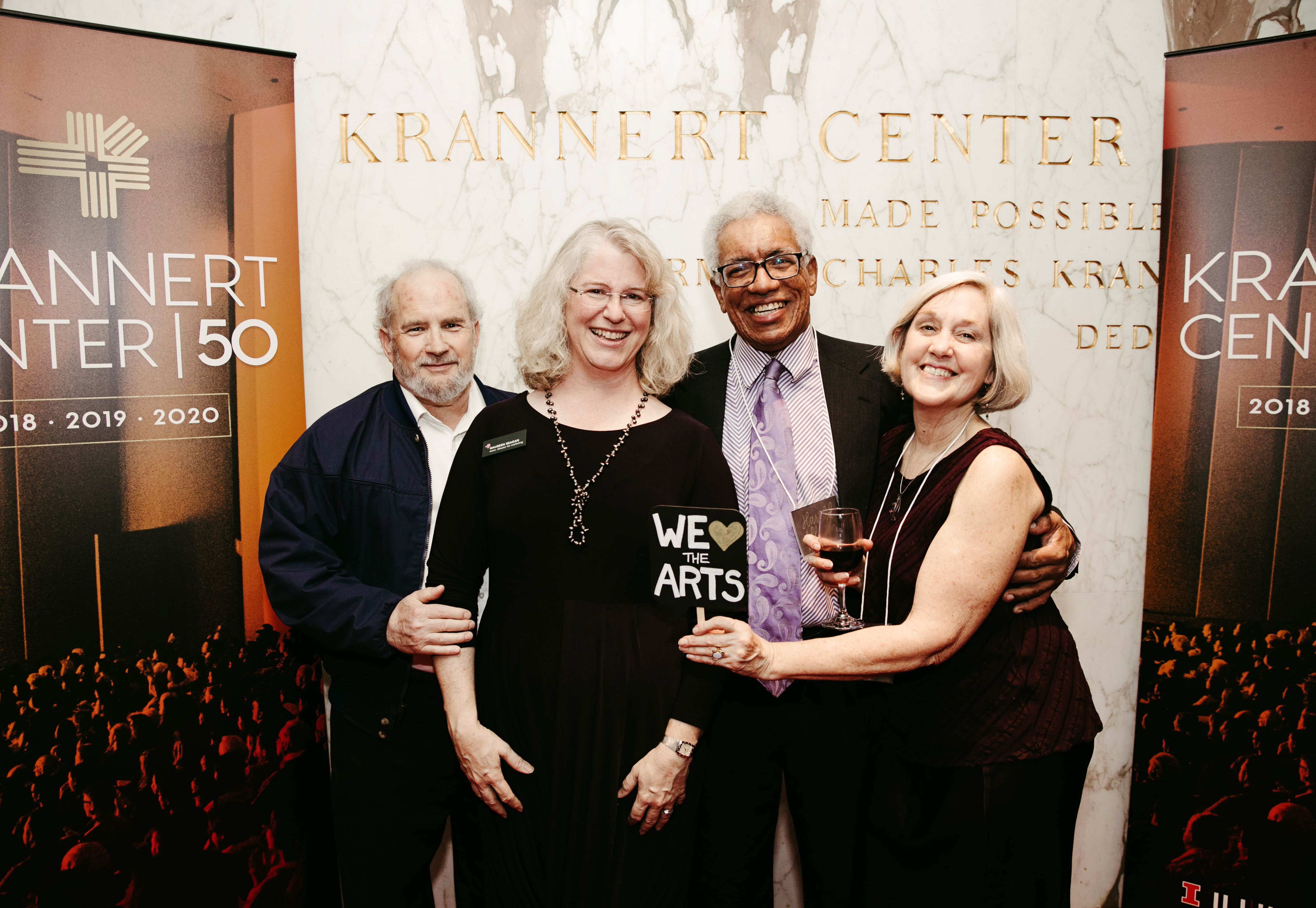
She says that with “deep gratitude” for the support the Center already receives from the university, donors, foundations, and students through the student fee. But she believes additional investment is essential. The building itself, she points out, is approaching 60 years old, and work on its continued restoration and revitalization needs to be prioritized, including improvements to production systems, safety systems, and the building’s exterior. She also imagines a future with even deeper campus and community connections: more collaborations, additional spaces for creating and experiencing the arts, and perhaps even a living-learning community or mixed-generational housing affiliated with Krannert Center.
In addition, she wants the Center to continue to vibrantly support its resident academic departments.
“What I love is that pulse…it’s Music, Theatre, Dance, Lyric Theatre, the resident orchestra and chamber orchestra, the visiting artists, and the students, such as the students in Intermezzo who are radiating energy at lunchtime,” she says. “For me, that energy is crucial.”
So what happens when someone who has spent 39 years at Krannert Center finally walks out the door? For Reagan, the answer is wonderfully simple: not much of a schedule.
“For a time, my rule of retirement will be, ‘make no obligations.’”
She plans to see performances—without worrying about them in ways she had to as a staffer.
Instead, she intends to be “the nicest patron ever.” Reagan also expects she will continue advocating for Krannert Center in everyday conversations.
But retirement will also be about rediscovering life beyond work. She wants to stay active, take care of her health, cook more, garden, travel extensively, and finally tackle some of the household projects she has postponed. But Reagan is equally interested in smaller adventures.
“I believe in finding interest anywhere we go,” she says. “Whatever the location, you can walk around for a few blocks and suddenly realize you’re not home.”
There is one final thing she wants to make clear about her retirement: she is not disappearing. Does that mean Krannert Center will remain part of her life?
“Yeah, absolutely. Absolutely,”
She is looking forward to being in the audience, experiencing performances without thinking about the logistics behind them, and appreciating the people who make them possible.
And perhaps that is the most fitting way to think about Maureen Reagan’s next chapter.
After 39 years of making things happen behind the scenes, she gets to sit down, take a breath, and simply experience the art.
“I’m just really grateful,” she says.